With interest rates near a decade-high, Arrived is leveraging the opportunity to open another avenue for real estate investment—residential real estate-secured private credit.
The Arrived Real Estate Income Fund invests in short-term financing for professional real estate projects, providing the potential for high yields secured by residential housing.
With a historical annualized yield of 8.3%¹, a quarterly redemption program, and monthly dividend distributions, this fund is designed to give investors access to real estate-backed income.
How the Arrived Real Estate Income Fund works
The Arrived Real Estate Income Fund offers investors a straightforward avenue to real estate-backed debt investments. Operating on a simple premise, the fund strategically allocates capital into short-term loans that finance various real estate projects, including renovations, rehabs, and new home constructions. These projects are managed by experienced professionals in the real estate industry, ensuring a level of expertise and oversight.
Investors in the fund can expect their capital to be deployed across a diversified portfolio of loans, each generally averaging 6 to 36 months in duration. Individual loans will typically range from $100,000 to $500,000, though the fund will evaluate loan opportunities from $50,000 to $10,000,000 and may exceed those ranges in certain circumstances. This diversified approach is designed to spread exposure across different projects and markets. The fund seeks to generate returns primarily through interest payments collected on the loans, which are distributed to investors monthly.
With a focus on income generation and capital preservation, the Arrived Real Estate Income Fund offers investors a transparent and accessible way to gain exposure to real estate-backed debt without the responsibilities of direct property ownership.
Arrived Real Estate Income Fund highlights
The Arrived Real Estate Income Fund simplifies and removes barriers to investing in real estate debt.
Key highlights:
- Historical Yield: 8.1% annualized dividend paid since fund launch
- Liquidity: Expected quarterly liquidity options offer flexibility.
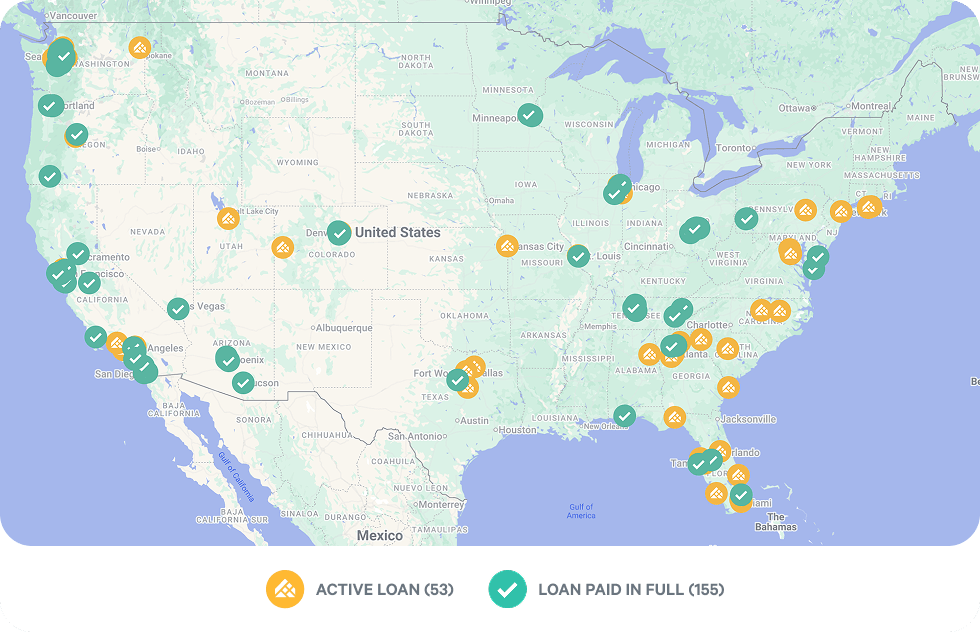
- Diversified Portfolio: The fund invests in a diverse pool of real estate-backed loans, mitigating risks and enhancing stability.
- Monthly Dividend Payouts: Investors enjoy regular monthly dividend payouts, enhancing cash flow.

Types of investments
The Arrived Real Estate Income Fund will typically focus on these loan areas:
New construction
This type of financing involves funding the construction of entirely new residential properties. New construction financing typically covers the costs of land acquisition, permits, materials, labor, and other expenses related to building a new structure.
Bridge loan
Bridge financing is a short-term loan bridging the gap between purchasing a new property and selling an existing one. It provides borrowers with immediate access to capital while they wait for longer-term financing or the sale of their property. Bridge loans often finance the purchase or renovation of a property for the purpose of refinancing or selling it within a relatively short time frame.
Renovation
Renovation financing involves funding the renovation or rehabilitation of existing residential properties. This type of financing supports the refurbishment, repair, or improvement of properties to enhance their value or appeal. Renovation projects may include upgrading outdated features, repairing structural issues, or modernizing amenities.
Learn more about the types of real estate debt in Introduction to Real Estate Debt Investing.
Selection criteria
The Arrived Real Estate Income Fund is built around disciplined underwriting. Before we acquire a loan, we evaluate the borrower, the property, and the loan structure to determine whether it fits our strategy. Our goal is to build a portfolio of real estate-backed loans focused on income generation and capital preservation.
Borrower’s experience and creditworthiness
We look closely at the borrower’s track record, financial strength, and ability to execute. Our preference is to work with experienced real estate professionals who have successfully completed projects like the one they’re financing and have a history of meeting their financial obligations.
Why it matters
The borrower plays a major role in the outcome of any project. Strong borrowers can help reduce the risk of delays, budget issues, and repayment problems. That is why borrower quality is a key part of our underwriting process.
Loan to after-repair value
We also evaluate loan-to-after-repair value, or LTARV, which compares the loan amount to the appraised value of the property after the planned work is complete. In general, we prefer loans with a conservative LTARV, typically below 70%.
Why it matters
A lower LTARV indicates greater value in the property relative to the loan amount. That cushion can provide additional protection if a project runs into challenges or market conditions change.
Loan position
The Arrived Real Estate Income Fund focuses on first-position loans secured by residential properties.
Why it matters
In the event of a default or foreclosure, first-position loans are repaid first. That added priority is an important part of how we think about downside protection.
Property location
Location is another important part of our underwriting. We use data and market analysis to evaluate both the project and the local market, and we invest across markets nationwide to build a more diversified portfolio.
Why it matters
Local market conditions can affect both property values and exit options, including a sale or refinance. By focusing on markets with stronger fundamentals and diversifying across geographies, we aim to build a more resilient portfolio.
Loan case studies
Here are a few examples of the types of loans chosen for the Arrived Private Credit Fund.
1. Arvada, CO
The Arrived Private Credit Fund financed 3 of 5 parceled buildings near the end of construction. Our bridge loan extended the borrower’s timeline to refinance or sell, and after 12 months the loan was repaid in full.
- Loan Type: Bridge
- Loan Total: $3,968,796
- Total Completed Value: $7,095,000
- Loan to After-Repair Value: 55%
- Loan Duration: 12-month hold
- Loan Status: Paid in full
2. Seattle, WA
This Seattle renovation transformed a $975,000 purchase into a home listed for $2.2M. The Arrived Private Credit Fund provided a $1.69M loan to support the project, which was repaid in full.
- Loan Type: Fix & Flip
- Loan Total: $975,000
- Total Completed Value: $2,245,000
- Loan to After-Repair Value: 70%
- Loan Duration: 18-month hold
- Loan Status: Paid in full
3. Miami Shores, FL
This South Florida development financed the construction of a new luxury home. The Arrived Private Credit Fund provided a $3.85M construction loan to support the project through completion and sale, and the loan was repaid in full after an 18-month hold.
- Loan Type: New Construction
- Loan Total: $975,000
- Total Completed Value: $2,245,000
- Loan to After-Repair Value: 70%
- Loan Duration: 18-month hold
- Loan Status: Paid in full
Managing risk
Real estate debt investments offer enticing prospects for returns but also carry inherent risks. The Arrived Real Estate Income Fund recognizes the importance of diligent risk management in safeguarding investor capital and optimizing long-term performance. Here's how the fund addresses various risks:
Renovation risk
One of the primary risks associated with real estate projects is the uncertainty surrounding renovations or rehabilitation phases. The Arrived Real Estate Income Fund tackles this risk head-on by implementing rigorous due diligence processes for each project. Before extending financing, the fund evaluates the viability and feasibility of renovation plans, scrutinizing factors such as project scope, budget, and the project team's track record.
Additionally, the fund may incorporate contingency plans and performance milestones to ensure projects stay on track and mitigate the risk of delays or cost overruns. By adopting these measures, the fund aims to minimize renovation-related risks and enhance the likelihood of successful project completion.
Market risk
Real estate markets are inherently dynamic and susceptible to economic, social, and geopolitical fluctuations. The Arrived Real Estate Income Fund maintains a vigilant stance on market trends and indicators to navigate potential market volatility. The fund remains attuned to shifts in supply and demand dynamics, interest rate movements, and macroeconomic conditions through continuous monitoring and analysis. Armed with this insight, the fund can proactively adjust its investment strategies and allocation decisions to capitalize on emerging opportunities or mitigate risks posed by adverse market conditions.
Borrower risk
Partnering with experienced and creditworthy borrowers is crucial to mitigating borrower-related risks in real estate debt investments. The Arrived Real Estate Income Fund prioritizes collaboration with reputable borrowers with a proven track record of successful projects and timely loan repayments. By conducting thorough borrower due diligence and assessing factors such as financial stability, past performance, and industry reputation, the fund seeks to minimize the risk of default or non-performance. The fund diversifies its loan portfolios across various borrowers, projects, and geographic regions to reduce exposure to borrower-specific risks.
Learn more about how loans are evaluated and repaid in What Is the Capital Stack?
Watch the Arrived Real Estate Income Fund webinar
Investing in both debt and equity can be beneficial for a well-balanced portfolio. If you’re looking to diversify your real estate investments, the Arrived Real Estate Income Fund is an easy way to access real-estate-backed debt. We’ve removed barriers to this investment vehicle at a time when high interest rates offer investors an attractive yield backed by quality real estate.
For additional educational resources on investing in real estate-backed debt:
FAQ
Who Can Invest?
How much can I invest?
What type of products are available on Arrived?
Will I have any responsibilities for managing properties I invest in? If not, who is responsible?
What type of returns can I obtain?
Disclosure
The opinions expressed in this article are for general informational purposes only and are not intended to provide specific advice or recommendations for any individual or on any specific security or investment product. The views reflected in the commentary are subject to change at any time without notice.
View Arrived's disclaimers¹ Historical annualized yield is current as of September 2026 and reflects The Real Estate Income Funds' trailing 12-month dividend distributions, annualized and divided by the current NAV per share over that period, net of fees and expenses. Distributions are not guaranteed and may be reduced or suspended at any time. Any historical returns, expected or target returns, or probability projections may not reflect actual future performance and are not a guarantee of future results. All securities involve risk and may result in significant loss, including the entire amount of capital invested. Figures may change over time and should be verified against current source materials. For more information, refer to the Offering Circular.